木棉花的春天
情暖八一 微光送爱——九江、景德镇两地开展“微光行动”慰问退役军人_我的网站

一 | 八一建军节来临之际,为大力弘扬拥军优属优良传统,切实关爱功臣与退役军人,江西体彩九江、景德镇两地分中心相继联合当地退役军人事务局开展“微光行动”系列公益活动,以务实举措践行“来之于民、用之于民”的公益初心。
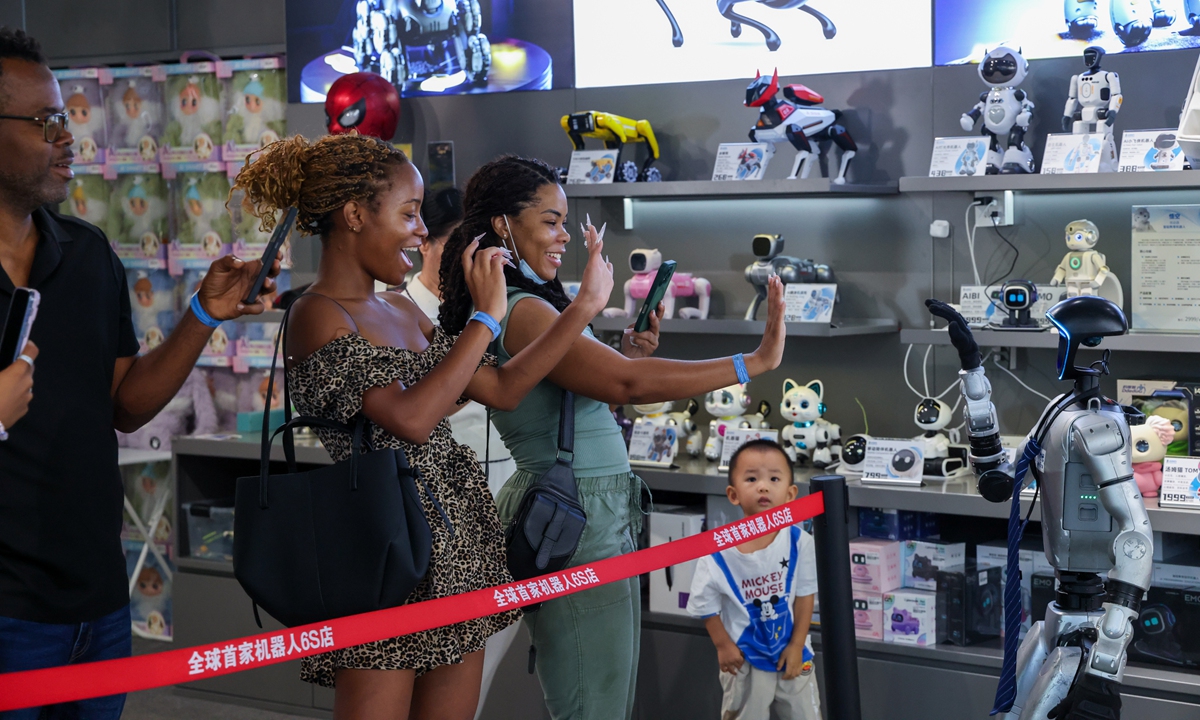
Photo released on August 9, 2026 shows tourists from Jamaica interacting with a humanoid robot at the world's first robot 6S store in Longgang District, Shenzhen, South China's Guangdong Province, on August 4. Photo: XinhuaChina's cutting-edge industrial upgrade witnessed two major landmarks on Monday, marking the country's full-fledged global lead in humanoid robotics and further solidifying the rise of its "new new three" strategic sectors — robotics, artificial intelligence and innovative medicine.
Industry data showed that Chinese vendors accounted for more than 97 percent of global humanoid robot shipments in the first half of 2026. Additionally, Chinese robotics firm Unitree Robotics began its share subscription process for its listing on Shanghai's stock market, becoming the first humanoid robot A-share stock.
The global humanoid robot shipments reached approximately 19,100 units in the first half of the year, surging 272 percent year-on-year. The market saw a leadership shift, with Chinese robotic company AGIBOT overtaking Unitree to become the world's largest humanoid robot vendor. China also represented more than 85 percent of global demand, according to the latest research from Smart Analytics Global (SAG).
As the former global leader in 2025 with annual shipments of 5,500 units, Unitree Robotics set its IPO offering price at 150.8 yuan ($22.35) per share on Monday. The initial public offering (IPO) is expected to raise 6.1 billion yuan, meaning an estimated market capitalization of around 61 billion yuan, according to media reports. The final online subscription winning rate will be 0.0181 percent, Unitree said on Monday.
The breakthroughs in humanoid robotics represent the latest landmark of China's booming "new new three" industries, which are emerging as core pillars driving the country's high-end manufacturing upgrade, export expansion and future economic growth.
Driving forces The rapid and comprehensive rise of China's robotic sector stems not merely from policy incentives, but from integrated advantages in complete manufacturing chains, forward-looking institutional arrangements and massive real-world application scenarios, industry analysts noted.
"The answer lies not in mere policy slogans, but in the synergies rooted in its manufacturing base, early institutional frameworks, and vast application scenarios. These factors have driven the 'new new three' industries onto the global stage," Zhang Xiaorong, director of the Beijing-based Cutting-Edge Technology Research Institute, told the Global Times on Monday.
A robust supply chain has been decisive. The localization rates across China's robot industry chain have risen markedly in 2026, with core components shifting to domestic control, CCTV News reported, citing an executive of a Shenzhen-based robot company, who said that more than 90 percent of key parts for its humanoid robots are sourced domestically.
"No other market is better suited for the robotic industry than China," the executive said.
Institutional analysis noted that the domestic production rate of Unitree Robotics' supply chain reaches 90 percent, while all core components are fully self-developed.
Zhang also said the large domestic market serves as a unique testing ground.
"Strong robot exports reflect advances in complete machine design, system integration, scenario algorithms, rapid delivery, and cost control, alongside continued localization of reducers, servo systems, and sensors. Large-scale applications in new energy vehicles, electronics manufacturing, and warehousing provide frequent iteration and engineering validation," said Zhang.
Institutional foresight also played a role. Robot manufacturing was first listed as an independent industry in the national standard for industry classification in October 2017, with sub-categories including "industrial robot manufacturing" and "special operation robot manufacturing" following in 2023.
Analysts noted that this early classification facilitated later policy support, capital-market positioning, and statistical monitoring.
In June 2026, several ministries launched a special program for real-scenario training of humanoid robots and embodied AI.
Customs adjustments, effective from January 1, added specific tariff codes for intelligent biomimetic and cleaning robots, simplifying export clearance.
Insurance coverage also followed. In June, China Export & Credit Insurance Corp issued an insurance policy for AGIBOT's embodied robot export project, providing overseas risk coverage.
Supported by complete industrial chains, rich scenarios and systematic policy guarantees, China's robotic sector has built an unshakable global edge, experts noted.
A faster paceOfficial data showed that China has more than 400 complete humanoid robot models - over half the global total - while quadruped robots account for nearly 70 percent of worldwide sales.
"China may produce more than 100,000 humanoid robots this year, with even higher growth expected in the following years, pointing to long-term opportunities in a sector with deep potential," Yang Delong, chief economist at Shenzhen-based First Seafront Fund, told the Global Times on Monday.
China's robot export momentum has also reached new heights. After becoming a net exporter of industrial robots for the first time in 2025, China's industrial robot exports reached 6.29 billion yuan in the first half of 2026, reaching 141 countries and regions, official statistics show. Surgical robot exports rose 3.3 times year-on-year. Overall robot exports grew 359 percent.
AGIBOT, the champion of humanoid robot shipment so far this year, illustrated the rapid scaling: Its 15,000th embodied AI robot rolled off the line on June 28, less than three months after the 10,000-unit milestone.
All units are being delivered to domestic and overseas customers for use in 3C (computer, communication and consumer electronics) manufacturing, warehousing and logistics, and commercial services, AGIBOT told the Global Times.
Jiang Qingsong, company partner and co-president of AGIBOT, told the Global Times on Monday that the company aims for overseas sales to exceed 30 percent of its total in 2026 and potentially surpass 50 percent later.
Strong progress in robotics is closely backed by China's booming artificial intelligence sector.
Hugging Face's latest report found that over the past year, "Chinese models quickly accounted for the plurality or 41 percent of downloads," surpassing the US for the first time.
On the OpenRouter platform, Chinese AI models' token usage reached 34.25 trillion in the week ended Sunday, meaning roughly half of global share, while remaining ahead of US models for the 15th consecutive week.
Yang noted that China's AI progress is supporting growth across six frontier sectors - robotics, semiconductors, computing power and algorithms, commercial spaceflight, solid-state batteries, and biomedicine.
In terms of innovative drugs, by the end of 2025, China had 4,751 innovative drugs in development - 33.7 percent of the world total - making it the global leader in the pipeline.
Outbound licensing deals totaled about $110 billion in the first half of 2026 - already 80 percent of the full-year 2025 figure - with Chinese firms occupying eight of the global top 10 pharma deals. During the same period, 38 innovative drugs were approved, according to data from National Medical Products Administration.
Benefit the worldThe vigorous rise of the "new new three" industries marks China's third major upgrade in export structure, following the traditional "old three" (garments, furniture and home appliances) and the "new three" (new energy vehicles, lithium-ion batteries and photovoltaics). Each industrial iteration features higher technological content, stronger innovation capacity and deeper integration into the global economy.
China's breakthroughs in robotics, AI and innovative medicine deliver tangible benefits to global industries and consumers.
For example, AGIBOT's European representative Sandy Liu told the Global Times that universities and large manufacturers in automotive and warehousing are the company's main users in Europe, driven by rising labor costs and the need for new solutions.
Chinese open-source AI models have transformed high-end artificial intelligence technology from exclusive luxury resources into affordable, accessible digital infrastructure, benefiting global startups and developing economies. Innovative drug outbound licensing also accelerates global research collaboration and improves global patient access to cutting-edge treatments, analysts pointed out.
China's role in global trade is shifting from single manufacturing links toward a deeper embedding in technology, systems, and standards. What remains constant is the innovation that injects valuable certainty into the world economy and supports more inclusive globalization, analysts noted.
。九江:物资暖人心,共忆峥嵘岁月7月29日,体彩九江分中心联合九江市退役军人事务局,在瑞昌市光荣院开展“情暖‘八一’关爱功臣”微光公益慰问活动,覆盖永修、瑞昌、修水、都昌四所光荣院。活动前期,市退役军人事务局精准摸排院内优抚对象需求,九江体彩据此采购了中老年纯棉夏装、冰丝凉席、空调被、防滑凉拖、冰丝护膝、大容量316不锈钢保温杯、防暑营养礼盒及欧姆龙血压监测仪等三百余件实用物资,全方位解决老兵夏季纳凉、日常起居及健康监测等难题。活动现场,工作人员将慰问物资送到老人手中,并围坐交流,仔细询问老战士们的身体状况与饮食起居,认真倾听老兵讲述军旅故事,重温红色记忆,向他们致以崇高敬意。老功臣们接过慰问品倍感欣慰,纷纷感谢社会各界的挂念与体彩送来的贴心物资。

二 | 景德镇:体检护安康,尊崇氛围浓7月30日,体彩景德镇分中心联合浮梁县退役军人事务局,在景德镇市第二人民医院为浮梁县退役军人开展专项健康体检服务。现场“致敬老兵守家国 体彩微光送安康”的横幅烘托出尊崇温情氛围。前期,经浮梁县退役军人事务局精准摸排,体彩景德镇分中心定制了40张爱心体检卡,依托医院专业资源为老兵提供系统化体检。体检当日,医院开辟专项通道,合理安排流程,由医护人员引导老兵有序完成各项检查。医务人员细致开展问诊与健康筛查,并针对中老年常见病普及养生防病知识,周到服务获得一致好评。老兵们表示,免费体检切实回应了健康需求,让大家真切感受到社会的尊重与温暖。一直以来,江西体彩始终坚守公益使命,持续聚焦退役军人等重点群体开展暖心帮扶。下一步,各地分中心将持续深化公益举措,常态化开展走访慰问与志愿服务,以公益微光汇聚拥军爱民力量,积极营造全社会尊崇军人、关爱功臣的良好风尚。

三 |
Current article:http://q1tlgp.tuncuansazhuandengqiaofen.bond/news/20260826_969.html
Published on:07:11:58
